Amber Trails: Reading HCI 2009 Through Its Informal Online Record
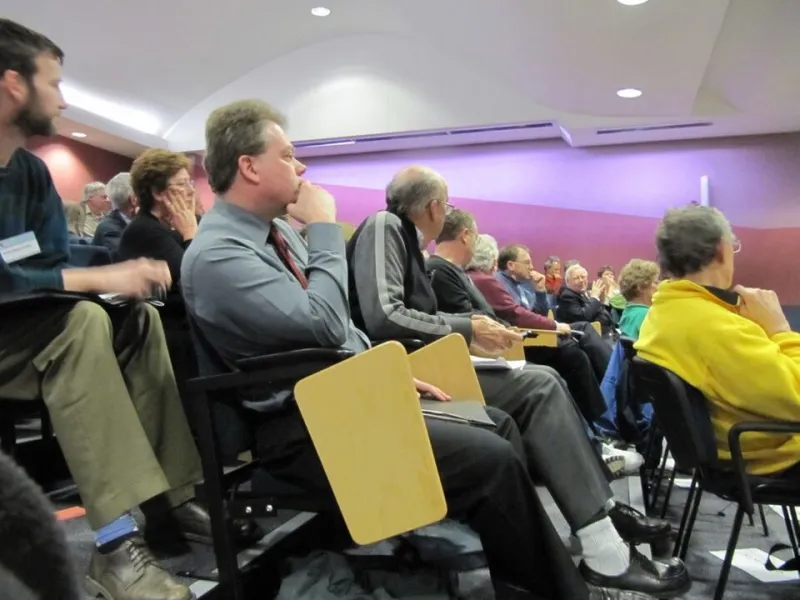
Photo: Bill Nicholls, CC BY-SA 2.0, via Wikimedia Commons
A Trail Made of Small Things
The formal record of HCI 2009 is orderly: papers, abstracts, a programme, a set of proceedings. The informal record is not. It survives as short messages posted during sessions, personal blog recaps written days later, and shortened links whose destinations have often vanished. Read together, these fragments form an amber trail through the conference. They do not replace the official archive. They show how the event was experienced, debated and carried beyond the room.
As of 2026, that trail is still recoverable in part. Archived Twitter posts, blog indexes, personal websites and citation trails preserve enough to reconstruct a partial chronology. The reconstruction is necessarily uneven. Some delegates posted frequently; most did not. Some sessions attracted comment; others left no trace. The historian must work with what remains rather than with what was representative.
The Shape of the Informal Corpus
The informal corpus has three broad layers. The first is the live post: brief, time-stamped and often reactive. It records a phrase from a speaker, a room change, a question from the floor or a joke that did not survive into the proceedings. The second is the blog recap: longer, retrospective and shaped by memory. It may summarise a keynote, compare parallel sessions or reflect on the conference as a whole. The third is the link trail: shortened URLs to slides, photographs, papers and related commentary. Each layer has its own distortions.
Live posts are immediate but thin. They favour the memorable phrase over the argument. Blog recaps are richer but retrospective; they impose narrative on events that were still unfolding. Link trails promise access to supplementary material, but link rot has removed much of what they once connected. A shortened link in an archived post is therefore both evidence and absence. It tells us that something was shared, even when we can no longer see what.
What the Programme Could Not Record
The official programme records what was scheduled. The informal record records what happened around the schedule. It captures the audible reaction to a paper, the migration between parallel rooms, the impromptu conversation in a corridor and the practical adjustments that conferences absorb without minute-taking. These are not trivial details. They are the social texture through which a discipline reproduces itself.
For UK UX research, this texture matters. HCI 2009 took place at a point when the field was consolidating its academic and professional identities. The formal papers show the research questions of the moment. The informal posts show how those questions were received, which ones travelled beyond their session and which speakers became reference points in later conversation. They also show the limits of that reception. A lively post does not prove consensus; a silent session does not prove indifference. The informal record is a guide to attention, not a measure of importance.
From Corridor Gossip to Public Commentary
The most significant change visible in this material is not technological but social. In 2009, conference commentary was moving from the corridor to the public platform. A remark that might once have stayed among a few delegates could now be posted, linked and archived. This made conference discussion more visible, but it also made it more performative. Delegates wrote for an audience that included people who were not present. The backchannel was therefore both a record of the conference and a participant in it.
That shift should not be overstated. Access was uneven. Not every delegate used Twitter or kept a blog; not every session was equally postable. The informal record over-represents the digitally active and the socially visible. It is a history of commentary as much as a history of experience. For the UK UX community, however, it marks an early stage in the public discussion of conference work that later became routine.
Reading Amber
Amber preserves, but it also colours. The informal record must be read with the same care as any other archival source. A post is not a transcript. A blog recap is not a neutral summary. A link is not a document. Each requires context: who wrote it, for whom, when, and in response to what. Where possible, the informal record should be cross-checked against the programme, the proceedings and the physical archive of the conference.
The reward is a fuller account of HCI 2009 as an event rather than a publication. The proceedings tell us what the field wrote down. The informal trail tells us what delegates noticed, repeated and argued about. For an archive devoted to preserving the conversations that shaped UX, that distinction is central. The amber trail is incomplete, but it is not incidental. It is one of the ways the conference continued after the rooms emptied.