Those Who Wore the Lanyard: HCI 2009’s Volunteer Rota as a Labour Record
Conference histories tend to be written from the centre outwards. The keynote is transcribed, the paper is cited, the panel is summarised, and the proceedings are bound. The student volunteer, meanwhile, is often preserved only as a blur at the registration desk or a name on a rota that nobody thought to keep. For the HCI 2009 Archive, that omission is not a minor gap. It is a clue about how academic events are sustained, who is credited for sustaining them, and how early-career UX work becomes visible — or does not — in the historical record.
HCI 2009’s student volunteer programme belongs in the archive precisely because it sits between administration and professional formation. The volunteers were not delegates in the ordinary sense, nor were they staff. They carried clipboards, checked badges, directed speakers, managed queues, and learned the conference from the inside. In 2026, as UK UX research continues to debate invisible labour, research operations, and the uneven costs of professional entry, the volunteer rota reads less like ephemera and more like evidence.
The Rota as an Administrative Document
A conference programme records intent: what the organisers wanted to happen, in what order, and under whose name. A volunteer rota records dependency. It shows who was required to be in which room at which hour, how many shifts were assigned, how breaks were distributed, and which tasks were considered suitable for temporary labour. Unlike the printed programme, the rota is repetitive and granular. It documents duration rather than prestige.
Surviving briefing notes add another layer. They set out scripts for registration, escalation routes for missing speakers, instructions for audio-visual equipment, and the delicate business of moving academics between rooms without appearing to move them. These are operational genres, not scholarly ones, which is partly why they are so rarely archived. Yet they reveal the conference as a working system. The system depended on students who were briefly granted access to the machinery of academic life and asked to keep it running smoothly.
Badge Colours and the Boundaries of Authority
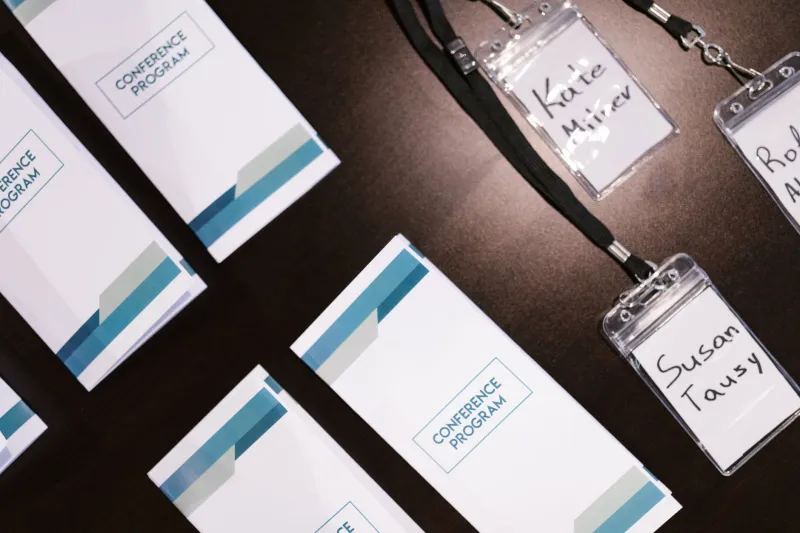
Badge colours are among the smallest and most revealing artefacts of any conference. They sort people without speaking to them. At HCI 2009, as at many UK events of the period, the volunteer badge marked a particular kind of presence: inside the venue, but not fully of it; able to direct delegates, but not to decide disputes; close enough to speakers to carry messages, but not close enough to claim authority.
That position is worth recording because it resembles a great deal of later UX work. Research assistants, studio coordinators, participant recruiters, and operations staff often possess detailed knowledge of how a project runs while remaining absent from its public account. The volunteer badge formalised a temporary version of that arrangement. It gave access, but it also marked a boundary. The archive should preserve such distinctions without romanticising them. Access is not the same as recognition, and proximity is not the same as credit.
What the Archive Does Not Say
A rota can tell us that a volunteer was assigned to a registration desk from eight until ten in the morning. It cannot easily tell us how tiring that shift was, how much emotional labour was involved in calming a lost delegate, or how many volunteers were quietly moved to cover an absent colleague. The documentary record is thin at exactly the points where labour becomes human.
Nor does the official conference record tend to name volunteers alongside reviewers, chairs, or exhibitors. Acknowledgement lines favour formal roles. This is not necessarily a story of exploitation; many student volunteers gained valuable access, met researchers they would not otherwise have encountered, and used the conference as a first view of academic life. But the absence of volunteers from the official account does shape what the archive can say about professional formation. It makes the volunteer programme look like background rather than infrastructure.
From Corridor to Career
Where volunteer names can be traced into later roles, they often lead into the wider UK UX community: doctoral study, research posts, design consultancies, local meet-ups, and the unglamorous committee work that keeps professional networks alive. Such traces cannot prove causation. A conference shift does not make a career. But it can function as an informal apprenticeship in vocabulary, manners, and proximity. Volunteers learn how papers are discussed, how speakers are handled, and how a discipline presents itself to itself.
That learning is part of the conference’s legacy, even if it rarely appears in proceedings. For historians of HCI, the volunteer rota is a record of entry-level participation. It shows how a UK UX workforce was not simply taught in lecture halls but also absorbed through corridors, registration queues, and the rehearsal of small administrative competences.
A 2026 Reading
The volunteer programme should not be remembered as a sentimental footnote. It should be catalogued as labour. In 2026, archives of HCI 2009 can usefully collect rotas, briefing notes, badge samples, and short oral histories from former volunteers. Such material would allow future researchers to ask who was admitted to the conference system, what they were asked to do, and how those tasks connected to later professional identities. The point is not to celebrate overwork, but to make visible the people who made the conference run. The lanyard is a small object. In the archive, it is also a labour record.